Friday, 16 March 2012

Flowers in the House
and Signs of Spring


Every year I have this dream that this will be the one where I manage to keep flowers in the house all year around. Invariably I fail, but this year I seem to be doing better than previous ones and particularly at the moment. Cut flowers, often wild, will come in season, but for now the time belongs to pots of spring bulbs and other early flowering plants. Of course the well organised would plan ahead, potting up bulbs the previous autumn in preparation for the coming spring; always thinking a few months in advance. These are skills that I am trying to foster (last year I even got so far as buying the bulbs), but still this year I find myself resorting to pots of things I find at the nurseries.

So far we have had daffodils that for a few weeks gave us a much needed lift, before becoming rather pale and leggy in the low light of the living room in late winter. The best of these, and still in situ spreading its wonderful scent, was Bridal Crown. A tall variety with white double flowers and short leaves that, simply potted in a white bowl, had an almost Japanese arrangement feel about it.

Narcissus Tête à Tête' is a lovely daffodil,
although there is huge variation between
plants - the more compact the better.
Another pot of Tête à Tête, more compact that the one before, has just been given to us and has replaced the leggy ones. You see so many creative ways of potting daffodils and next year, when I really will be planting my own bulbs, I will try different bowls and tins, but for now everything goes into the wonderful old worn terracotta pots that we found.

Another treat were the stocks that were on sale at the nursery at the weekend. Traditionally of course they are bedding plants, but a group of three - each in its own pot - make a wonderful display and the scent is gorgeous; rich and sweet, like candy floss, which of course is exactly what they look like. Not bad for 30p each.

Although scentless the crown at the moment belongs to the ranuncula, again a bedding plant but one that is just so stunning that it can easily stand up to being used as table centre piece. It is related to the buttercup, which is one of those facts that makes you go 'oh yes, of course', when you first hear it. The sculpted curved petals open out from the middle in a way that makes you think it will never end. And for us it all started this morning; at 8am the plant was just showing signs of releasing its tight grip on the flower bud and by 9, a crown of petals had broken away. But come tea time it had almost opened fully, the dark edges giving way to pink petals - but still with the darker ball centre. It is just so beautiful.

Signs of spring

For mid-morning tea I wonder up onto the balcony, where the sun is warming on the back and could easily lul me into thinking about reading or writing up there. Luckily every few seconds a slight breeze drifts past and whispers 'it's only mid-march', causing me a slight shiver as though acknowledging her maternal warning. But its warm enough for half and hour or so.

I potter, just looking for the early signs of spring. There are no jobs to be done. Well, there are, but I don't intend doing them. The batch of tulip and daffodil bulbs, that I bought last autumn and left in a cupboard and which I only found and planted a few weeks ago, seem to be making up for lost time. They are behind those in the ground of course, but they'll come good. I planted them up in medium terracotta pots so that I can decide where to put them when they come into flower. If the weather is nice on the balcony they can be moved to a suitable spot, or else we'll bring them into the house. 

Matthiola incana 'Stocks Legacy Mixed' with their
amazing scent and candy floss flowers

Where as the ranuncula's unfurling can be measured in hours, almost minutes, the fig and grape vine are taking a more leisurely approach, although progress can been seen every day now. The rosemary is coming into flower, a spectacle so small that at almost any other time of year it would be missed, but in these very early days of spring even such a small flower is a treat. For a few years I have been meaning to collect some seed and sow up some fresh bushes, but invariably I forget and so just take a few cuttings of the new growth.

A few weeks ago I sorted out some of the old cuttings that had been lying around and threw out any that looked as though they hadn't taken, discaring them and the old soil in the main bed. But looking down now I see a thin twig poking out from under one of the lavenders, I would never had noticed it, except that a fresh bright green leaf is breaking out from the top. It is a current of some kind or a gooseberry, we'll find out in due course. Such dogged defiance is one of natures finest qualities and should be an inspiriation to us all.

Wednesday, 7 March 2012

The Watering Girl Brooch

A couple of days ago I was browsing on Flickr and came across this lovely Bird Pendant, created by pratriciaolazo. We bought dad a Hobbies treadle saw last Christmas and, despite spending a long time restoring it, I have never actually got to grips with using it. Seeing this bird pendant inspired me to have a go at creating something similar, as I needed a present.

I had a couple of pieces of thin (2mm) oak that I had cut off a recent project that seemed ideal, even if oak is perhaps not the easiest wood to start out with. For my first attempt I used an image of a dove that I downloaded and cut out. However, looking at it afterwards I realised that some of the lines that were lost as a result of it being a silhouette meant that it was not very clear what it was (plus I split it in half trying to put the eye in!).

For my second go I rather fell in love with a Watering Girl image, but was very concerned about the level of details and tight corners. I decided that if I was going to give it a go I would just have to accept that my version in wood would be very different and just to be happy with that.

Second go, not so close to the lines this time...
First of all I printed out the picture twice; one to cut out and trace around and one to have as a reference during the later stages. Even at the cutting out stage I made some decisions about what detail to keep and what to loose and by the time I had then traced around this onto the wood the outline was much softer and rounder. Size wise she is 4.5cm (1½") tall and 3.5cm (1¼") wide.

On my first go at the lady I did what I had said I wouldn't do and that was try and cut it out accurately using the treadle saw. Invariably I wobbled and hit the line pretty early on – it is just too small. No matter, I simply traced another and this time stuck to my instinct that I should just cut the shape roughly and use files to refine it.

Starting to take the wood down to the line using files
Once I had the shape in rough I mounted the piece in the vice and started to bring the edges down to the line. Now I have inherited three sets of files; large, medium and small. I have never used any of them before and could not find the box of the small files, so had to make do with the medium sizes. These were way too big really, but I managed so must have learnt something along the way.

It goes without saying that the wood is very fragile, it is important to mount the figure as low down in the vice as possible, particularly for the arm and watering can. Touching the wood reduces the vibration, as does only cutting on the push stroke.

With the back shaped I started to work on the delicate arm.
You have to work slowly; either you have the time to make it, or you don’t. To rush it just wouldn’t produce a pleasing result. I was removing it from the vice regularly to check how it looked the right way up, before removing a little more. I also kept a copy of the original drawing to hand to reference it against. 

Then once I had got as close to the lines as could with the files I had I sanded the lines off and looked at it again, without worrying about the original drawing. What did my little girl look like? I did a few modifications to the face and then rounded the feet a little more, before finally rubbing it over with very fine wet & dry and mounting it on a pin. I thought about waxing or oiling it, but in the end left it as is - it will darken with age.

With the lines removed it is almost finished, just the face to refine.
I was really pleased with the result, it took me about 2hrs to make (including the failed one) – but it was definitely worth the effort. I am sure that practice would make the process quicker, as would the smaller files which I must find.

Anyway, my wife seemed pleased with her present and I might just have found another new favourite distraction...


Tuesday, 6 March 2012

Under an Elm Tree by William Morris


"Midsummer in the country — here you may walk between the fields and hedges that are as it were one huge nosegay for you, redolent of bean-flowers and clover and sweet hay and elder-blossom. The cottage gardens are bright with flowers, the cottages themselves mostly models of architecture in their way. Above them towers here and there the architecture proper of days bygone, when every craftsman was an artist and brought definite intelligence to bear upon his work. Man in the past, nature in the present, seem to be bent on pleasing you and making all things delightful to your senses; even the burning dusty road has a look of luxury as you lie on the strip of roadside green, and listen to the blackbirds singing, surely for your benefit, and, I was going to say as if they were paid to do it, but I was wrong, for as it is they seem to be doing their best.

And all, or let us say most things, are brilliantly alive. The shadowy bleak in the river down yonder, which is — ignorant of the fate that Barking Reach is preparing for its waters — sapphire blue under this ruffling wind and cloudless sky, and barred across here and there with the pearly white-flowered water-weeds, every yard of its banks a treasure of delicate design, meadowsweet and dewberry and comfrey and bed-straw — from the bleak in the river, amongst the labyrinth of grasses, to the starlings busy in the new shorn fields, or about the grey ridges of the hay, all is eager, and I think all is happy that is not anxious.

What is that thought that has come into one’s head as one turns round in the shadow of the roadside elm? A country-side worth fighting for if that were necessary, worth taking trouble to defend its peace. I raise my head, and betwixt the elm-boughs I see far off a grey buttressed down rising over the sea of green and blue-green meadows and fields, and dim on the flank of it over its buttresses can see a quaint figure made by cutting the short turf away from the chalk of the hill-side; a figure which represents a White Horse according to the heraldry of the period, eleven hundred years ago. Hard by that hill-side the country people of the day did verily fight for the peace and loveliness of this very country where I lie, and coming back from their victory scored the image of the White Horse as a token of their valour, and, who knows? perhaps as an example for their descendants to follow.

For a little time it makes the blood stir in me as I think of that, but as I watch the swallows flitting past me betwixt hedge and hedge, or mounting over the hedge in an easy sweep and hawking over the bean-field beyond, another thought comes over me. These live things I have been speaking of, bleak and swallows and starlings and blackbirds, are all after their kind beautiful and graceful, not one of them is lacking in its due grace and beauty; but yesterday as I was passing by a hay-field there was an old red-roan cart-horse looking seriously but good-humouredly at me from a gap in the hedge, and I stopped to make his acquaintance; and I am sorry to say that in spite of his obvious merits he was ugly, Roman-nosed, shambling, ungainly: yet how useful he had been — for others. Also the same day (but not in the same field) I saw some other animals, male and female, with whom also I made acquaintance, for the male ones at least were thirsty. And these animals, both male and female, were ungraceful, unbeautiful, as ungainly as the roan cart-horse; yet they were obviously useful, for they were making hay before my eyes. Then I bethought me that as I had seen starlings in Hertfordshire that were of the same race as the Thames side starlings, so I had seen or heard of featherless two-legged animals of the same race as the thirsty creatures in the hay-field; they had been sculptured in the frieze of the Parthenon, painted on the ceiling of the Sistine Chapel, imagined in literature as the heroes and heroines of romance; nay, when people had created in their minds a god of the universe, creator of all that was, is, or shall be, they were driven to represent him as one of that same race to which the thirsty haymakers belonged; as though supreme intelligence and the greatest measure of gracefulness and beauty and majesty were at their highest in the race of those ungainly animals.

Under the elm-tree these things puzzle me, and again my thoughts return to the bold men of that very country-side, who, coming back from Ashdown field, scored that White Horse to look down for ever on the valley of the Thames; and I thought it likely that they had this much in common with the starlings and the bleak, that there was more equality amongst them than we are used to now, and that there would have been more models available amongst them for Woden than one would be like to find in the Thames-side meadows.

Under the elm-tree I don’t ask myself whether that is owing to the greater average intelligence of men at the present day, and to the progress of humanity made since the time of the only decent official that England ever had, Alfred the Great, to wit; for indeed the place and time are not favourable to such questions, which seem sheer nonsense amidst of all that waste of superabundant beauty and pleasure held out to men who cannot take it or use it, unless some chance rich idler may happen to stray that way. My thoughts turn back to the haymakers and their hopes, and I remember that yesterday morning I said to a bystander, ‘Mr So-and-so (the farmer) is late in sending his men into the hay-field’.

Quoth he, ‘You see, sir, Mr So-and-so is short-handed’.

‘How’s that?’ said I, pricking up my Socialist ears.

‘Well, sir,’ said he, ‘these men are the old men and women bred in the village, and pretty much past work; and the young men with more work in them, they do think that they ought to have more wages than them, and Mr So-and-so, he won’t pay it. So you see, he be short-handed.’

As I turned away, thinking over all the untold, untellable details of misery that lay within this shabby, sordid story, another one met my ears. A labourer of the village comes to a farmer and says to him that he really can’t work for 9s. a week any more, but must have 10s. Says the farmer, ‘Get your 10s. somewhere else then’. The man turns away to two month’s lack of employment, and then comes back begging for his 9s. slavery.

Commonplace stories of unsupported strikes, you will say. Indeed they are, if not they would be easily remedied; the casual tragedy cut short; the casual wrongdoer branded as a person out of humanity. But since they are so commonplace -

What will happen, say my gloomy thoughts to me under the elm tree, with all this country beauty so tragically incongruous in its richness with the country misery which cannot feel its existence? Well, if we must still be slaves and slaveholders, it will not last long; the Battle of Ashdown will be forgotten for the last commercial crisis; Alfred’s heraldry will yield to the lions of the half crown. The architecture of the crafts-gildsmen will tumble down, or be ‘restored’ for the benefit of the hunters of picturesque, who, hopeless themselves, are incapable of understanding the hopes of past days, or the expression of them. The beauty of the landscape will be exploited and artificialized for the sake of the villa-dweller’s purses where it is striking enough to touch their jaded appetites; but in quiet places like this it will vanish year by year (as indeed it is now doing) under the attacks of the most grovelling commercialism.

Yet think I to myself under the elm-tree, whatever England, once so beautiful, may become, it will be good enough for us if we set no hope before us but the continuance of a population of slaves and slave-holders for the country which we pretend to love, while we use it and our sham love for it as a stalking-horse for robbery of the poor at home and abroad. The worst outward ugliness and vulgarity will be good enough for such sneaks and cowards.

Let me turn the leaf and find a new picture, or my holiday is spoilt; and don’t let some of my Socialist friends with whom I have wrangled about the horrors of London, say, ‘This is all that can come of your country life’. For as the round of the seasons under our system of landlord farmer and labourer produces in the country pinching parsimony and dullness, so does the ‘excitement of intellectual life’ in the cities produce the slum under the capitalist system of turning out and selling market wares not for use but for waste. Turn the page I say. The hayfield is a pretty sight this month seen under the elm, as the work goes forward on the other side of the way opposite to the bean-field, till you look at the haymakers closely. Suppose the haymakers were friends working for friends on land which was theirs, as many as were needed, with leisure and hope ahead of them instead of hopeless toil and anxiety, need their useful labour for themselves and their neighbours cripple and disfigure them and knock them out of the shape of men fit to represent the Gods and Heroes? And if under such conditions a new Ashdown had to be fought (against capitalist robbers this time), the new White Horse would look down on the home of men as wise as the starlings in their equality, and so perhaps as happy."

First published by William Morris in Commonweal on the 6th July 1889 .

Click here to download a pdf version of the above article.

Wednesday, 29 February 2012

Pice ar y Maen (Welsh Cakes) for Breakfast

The weekends are a time when roles are reversed and invariably I have to get up first and, as it is the weekend, I am expected to return with breakfast. Usually this will be toast, but this morning as I was lying there, contemplating getting up, I realised that we were out of bread and that being a Sunday the deli wouldn’t open until 10am. For some reason (genuinely I have no idea why) I suddenly thought, ‘I’ll make griddle cakes!’. Which is odd, because I have never made them before; perhaps it was my distant Welsh blood speaking through the mists of time. 

I will be making them again though – a real success and very easy. It must have taken no more than 15/20 minutes, including making the coffee.

A Welsh Cake cooking in the traditional way.

Image from National Museum of Wales

Traditionally Welsh cakes would have been cooked on a bakestone (in fact one name for the actual cakes in Wales is Bakestones), which is a flat slap of stone that was heated in a fire and then used for cooking. More recently cast iron has replaced stone and they are cooked on a griddle pan over a range. Sadly we don’t have either, however we do have a panini maker that my mother bought me some time ago and which turned out to be just perfect.

They kept their shape so well during cooking that for afternoon tea, when using up the rest of the mix, I used shaped cutters instead of a round one. Once we get the bee-hives up and running I am looking forward to trying these out with honey rather than sugar.

If you look carefully at the image at the top you might see two things that would make my Welsh fathers turn in their graves. One thing that is there and shouldn’t be and one that isn’t there and ought to be... I’ll let on at the end.

Pice ar y Maen or Welsh Cake Recipe

(250g) 8oz self-raising flour
(75g) 3 oz butter
(1/4 tsp) pinch of salt
(75g) 3 oz currants or raisins
(75g) 3oz caster sugar
1 egg
a little bit of milk
Some extra sugar to sprinkle

They kept their shape so well I couldn't help
but use a different cutter for afternoon tea
Combine the fat and flour and then add in the sugar, salt and currants. Break in the egg and pour in enough dashes of milk to make it bind. Roll to the thickness of your little finger and cut using a cutter of your choice. Pop onto the griddle, bakestone, panini maker or heavy saucepan and cook until brown, turning once. Then sprinkle with sugar if so desired.

Do try these, they are so lovely and yet really easy. And the two historical errors in the picture? Well the Jam would certainly be frowned upon, whilst the lack of currants would have me banished from the sacred land!

Friday, 24 February 2012

Homemade Warping Frame

The completed warping frame with its first warp
We got our loom just before Christmas 2010; it is a Harrisville 36” loom with 8 shafts and 10 treadles. It belonged to someone who had come over from the states and then had to return, unable to take it back with them. Having cluttered up the bedroom of their friend for some time we saw an advert asking if anyone wanted it before it went to the dump... We jumped at the chance and have been the proud owners since. I cannot imagine that there are many Harrisville Looms in England as there is no distributor for them here.

That first Christmas we learnt to use it by weaving three scarves and two ties, which were given away as presents. These were made with a weaving book in one hand and the beater in the other, with the last one only being cut off and fulled late into the night before we set off to be with family. 

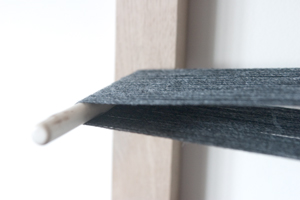
The frame is oak and
the pegs hazel
Given that we didn’t really allow ourselves much time to learn the process of weaving they came out quite well. However, one area where we did struggle was with the tension as we didn’t have a warping frame and so was using various Heath Robinson style contraptions involving chairs and sofas etc., none of which really worked satisfactorily.

I briefly looked at the Ashford warping frame, but at £75 ($120) pretty quickly dismissed it – not only on cost, but also because it was made in New Zealand and shipped over. I am sure that it is very nicely made, but it is only four bars with pegs coming out and so I set to making one. It has been an on/off project all through last year, but finally it is finished and we can return to weaving, as we haven’t touched it since the last scarf came off the loom that Christmas.

How to make a warping frame

Full plans for the warping frame can be download in .pdf by clicking here.

The frame has mortise and
tenon joints, secured with
copper pins

I used 20mm (¾”) oak for the actual frame as I have a pile of solid oak floorboards, but you could use any easy to work straight grain timber. I guess you could even use softwood as it isn’t under much load. The width of the frame timber is 45mm (1 ¾”).
The uprights are cut to 80cm (31 ½”) in length and 25mm (1”) long tenons are cut at the end, at a width of 6mm (1/4”). The horizontal members are 103cm (40 ½”) as this allows the spacing from peg to peg to be around 1m (39 ½”), which makes for an easy rough and ready warp length calculation. If you are more comfortable with imperial measurements you could always adjust it to make them a yard apart. I then cut the mortises in the horizontal members.

It is easier to drill the holes for the pegs before you assemble the frame, although I put them in at the end. For my pegs I used hazel; it is a local wood that grows in coppices and hence the rods are reasonably straight. It isn’t a particularly strong wood, but by simply debarking it and using it ‘in the round’ I am retaining the strength of the grain. It is quite important that the pegs are straight as a significant variation throughout the length of the peg will be reflected in the warp. However, it does only really need to be straight on one side (i.e. the outer one around which the warp turns). Quite whether these hazel pegs are straight enough I am not sure – I guess time will tell – if not I will replace them with oak dowel. The pegs are 16.5cm (6 ½”) long and around 12mm (1/2”) in diameter (in actual fact the diameter of the pegs are quite varied being hazel rods – which I love – but dowel would obviously give a consistent finish). Drill the hole slightly smaller than the pegs.

It is important that the pegs be square to the frame
On the left upright the centre of the top hole is 16.5cm (6 ½”) from the tenon shoulder, with the centre of the holes below being at 14cm (5 ½”) intervals. For the right upright the centre of the first hole is 3cm (1 ¼”) and then again they are every 14cm (5 ½”). All the holes are in the centre of the wood and each side has 5 pegs.

The upper horizontal member has the centre of the first hole 10cm (4”) in from the left handside, then two more, both at 20cm (8”) intervals. The lower member is the same, except you measure from the right hand edge. 

Assemble the frame and either glue the tenons or, as I did, peg them. Given that these were my first mortice and tenon joints I wasn’t about to risk drawboring with wooden pegs (I’ll save that for another day), but at the same time I am not keen on glue. So instead I pinned them with copper tacks, two in each tenon, straight through the side of the mortise – which has worked really well.

Download a .pdf version of the plan by clicking here
Once the frame is together it is just a matter of fitting the pegs with a wooden mallet, gently trimming the end and then tapping them home. Be careful that you don’t make it too tight and split the member, but tight enough so that they won’t fall out (no glue should be needed). Likewise stop and check them every so often with a set square to see that they are going in straight.

Finally screw in four brass hooks so that the frame can be mounted on the wall.

And there we are, another tool handmade – saving me money, teaching me new skills and reducing my impact on the environment. I dare say the Ashford one is a little more ‘polished’, but I rather like the natural look of ours. Right, time to get going on our first warp...

Wednesday, 22 February 2012

Recycling Wool


I love jumble sales. They are a real antidote to what is wrong with the world. For a start they are almost always for a charity – be it children, wildlife, historic buildings, cats or anything else that needs care. Secondly they rely on people recognising what it is that they no longer need and then offering that up for others to use. Likewise for the buyer it offers the chance to acquire a real range of stuff (far more eclectic than you’ll find on most high streets) at prices that are affordable. It is a wonderful celebration of what life should be like.

However, as anyone who has ever been to a jumble sale will attest to, all these high minded ideals can be a little hard to find once the door is opened and the baying crowd is unleashed on the tables, all overseen by a formidable army of older ladies eager to ensure that every item is found a new home and that, more importantly, every 20p is collected. In the heat of the moment there is little time for cool calm contemplation...

Which is the main reason why that lovely jumper I had been so pleased to find, was in actual fact an XL. I suppose that I could have taken it to a charity shop as there was nothing wrong with it, however it was made from Scottish spun tweed wool and in the end I decided to unwind it and recycle or upcycle the wool.

The jumper part way through being unwound
Ask almost anyone who has a wartime memory (as both my father and aunt do) and they will tell you that recycling wool was a perfectly normal thing to do as fibre had become hard and expensive to acquire. But even today the economics of it are surprising and, although I shudder at the idea of deciding what is worth doing by whether the pounds and pence add up, it does actually make financial sense.

I purchased the jumper for 20p and from that I obtained just over 600g (21oz) of usable Scottish tweed wool. If I was to go and buy that from Rowan it would be £5.90 per 50g (plus P&P), a total of around £72 ($112). It took longer than usual to unwind it (see below), maybe 6hrs, but it was a happy little task that I could do whilst listening to the radio and even in the car (no, I wasn’t driving). Of course if you get jumpers in angora, cashmere or alpaca the savings can be considerably more.

In weaving projects I have done before I have used recycled wool as the warp, but I have decided here to use the wool for both the warp and weft, in a straight forward tabby weave. It will be first time I have used the full 36” width of the loom, having only done scarves and ties before. For weaving I don’t do anything with the wool other than wind it onto a bobbin and then it’s always under tension during the process of weaving. For knitting you would certainly want to steam or gently wash the wool on a niddy-noddy for a while to release the crinkle. This particular yarn has a new texture to it, slightly raised where it has been on the outside of the jumper, however with this type of wool I think it only adds more interest.

How to unwind a jumper

Slightly vintage labels like this can be used
as a reminder of the fibre and its origin.
Firstly it is really important to ensure that your jumper was made in the correct way. There are two methods in making them up. The first uses panels and a stitch up the seams, usually from the same wool as the jumper is knitted in. This can be quite hard to see, but gently pulling the seam should show a thread running back and forth between the two panels. This is the one we want, because the second method – using an industrial overlocker – stitches the panels together (often with a cotton thread) and then cuts the end of the woollen seam. This results in a cut stitch at the end of each row and so lots of short lengths.

Once you are sure that you have the right sort of seams (and that you do actually want to loose the jumper!) cut along all the seams, being very sure to only cut the woollen thread holding them together. If you are successful you will know because you end up with two panels, the ends of which are uncut. Often at the base of the seam it will be strengthened by cotton thread stitching and it is almost impossible to unpick this. You just have to do the best you can and accept a few rows of lost wool - likewise up and around the shoulders. It is a process that is much easier to do than describe.

If you get to a problem (perhaps a damaged or stained area) you can cut out strips, so long as you do so along the row and not down through the rows. Then take off any sort bits until you get continuous rows again.
On this particular jumper the main body came away two rows at a time, which was slower as I had to wind it on to two bobbins.

Calculating how much wool you have.

Calculating the wraps per inch (wpi)
Once you have your wool into a ball or on a bobbin you can weigh it and calculate how much you have obtained. I got just over 600g (21oz) from this very large jumper, with 60g (2oz) of ‘waste’ wool that we will use for stitching or filling, plus there was a zip. If you were going to knit a jumper try to get a size or two above the one you are going to make or one that uses more wool (e.g. a polo neck). If it is vintage or attractive the label can be attached to remind you of the yarn’s fibre.

To calculate the length of the wool take a ruler and wrap the yarn around it, laying each wrap one next to the other along a 1” gap. To make it easier I have set a set square to a one inch gap, one day I’ll make a wooden gap with the calculations on the back. This particular wool is 16 wraps per inch (known as wpi) so therefore I am likely to have around 2400m (2,600 yds) of yarn. How did I come by this calculation? Well by using the many, many charts on the internet – of which each one says something different. You have to have a look at a few and then average them out and certainly when you are planning your project you need to allow a bit for error. A more accurate way would be to wind it around a known length (such as a niddy-noddy) to create skeins.

Old mill bobbins with the recycled wool
So there we have it two 100-year old mill bobbins being used again to hold recycled wool that is going to be used again! Such recycling should be the stuff of life...

Wednesday, 8 February 2012

Does the world need another blog?

William Morris: Hopefully not as serious
as he always looks and someone who
understood so much.

No, probably not. But then it is unlikely that we need half the stuff that modern life creates and yet still there it is. So I am sure that one more blog won’t make much difference. I think we can fit it in. Just.

So what’s it all about then?

Life. And a deep down belief that the current way of doing things just isn’t working, for us or for the planet.

Currently satisfying the needs of life (the things we need to survive) is causing the world great problems, and yet the irony is that the meeting of them presents the greatest opportunity for us to fulfil our innate creative desires, in a sustainable way. The problem is a great disconnect between the things around us and their creation – both in a global sense, but also in a very personal one. I doubt that many of us would purchase so many of the things that we do if we saw the environment in which they were created, devoid of compassion or care. And that flows over into the object – it is impersonal, identical and dead. We have no connection to it, no involvement in its production other than its consumption. Perhaps if this was just one or two objects in our lives it would be bearable – the almost unavoidable computer or phone. But it’s not, it's everything.

The moment that we take a step back from that, no matter how small, is an act of great love and compassion, towards ourselves, others and the earth. When we say, ‘no I am not going to buy that’, it is a great liberating step. It might be that you realise you don’t actually need it or that you can get it second-hand, but it might also be that you can make something to meet your needs.

That is really what this blog is all about, what happens when you try to live as lightly and yet also as creatively as possible. I am not unique in this aim by any stretch, but this is my story of what happens when I try it.

John Lane's Timeless Simplicity
says everything in 100 pages
that I could hope to express
in a lifetime.
It’s modest – really modest. But actually it is also just a little bit profound. Because to do all that you can to try and lessen your impact on others is all that anyone can ask you to do. And actually if we all did that many of the problems would pretty much disappear. The really sad thing is that in an effort to convince us that life is best bought with a 30-day money back guarantee, they have made us think that homemade is second best, that poor means poverty. And the truth is that whilst that can be the case, it needn’t be.

Of course it isn’t easy. Society makes sure of that. If you want to herd sheep you put up hedges and send out dogs so that the only easy route is the one into the pen. And I’ll try to fight my own pride in an effort to be honest about the challenges I face, but I passionately believe that it has the potential to be the most richest and rewarding of lives.

The rhythm of life (is a powerful thing)

Because the blog will follow the projects I work on it will develop a natural rhythm and journey. At the moment it is likely to be quite woodworking and indoor crafts focused, as its winter. Come spring and summer there will be much more from the allotment. Likewise the books and texts I read seem to come in patterns; for a while it will be several on one subject and then perhaps I will have a flight of fancy and immerse myself in something else. At the moment it is traditional woodworking and more specifically the traditional uses of different trees, but I can feel a change coming and have already ordered some library books on reading and interpreting the historical landscape.

It all sounds very heavy!

Yes, it does a bit doesn’t it? And perhaps I should be wary of setting such grand hopes. Certainly I want the normal posts to mix the very practical with a bit of background information, so perhaps this is as deep and heavy as we’ll go, but anyway we’ll see how we get on. 

I hope to avoid any egotistical ‘Hey, look at me and what I can do’, and instead use the blog to share some of the things I am working on or thinking about so that others may share their experiences too or be inspired to try it themselves. I am no creative genius, nor super talented crafts-person (as you’ll all too clearly see!) and so if I do succeed along the way the chances are that you’ll be twice as successful, if only you’ll give it a go.

"Let's go back to basics and remember that all we really have to do is put a roof over our heads and meals on the table. Beyond that our time can be better spent enjoying our lives, being with the people we love, creating things we love that don't harm the earth, and contributing something meaningful to the world." Elaine St James